
~Article by Danie Bester
If you’ve spent any time in a DPC classroom, you’ve heard me mention John Onderstall. He is one of the finest photography teachers I have ever met and one of the sharpest minds I know — armed with a sense of humour so dry you’re never entirely sure whether he’s joking. Few people have had a greater effect on me as a photographer: he has shaped the way I see and think about images, and over the years he has helped me curate my own work — there are few opinions I trust more. He lives in Johannesburg with his wife, Cheryl, and their two boys, and for his creative work he goes by John Fox — the name you’ll find some of his work at: Fox Galleries
John qualified in videography and spent his early years working as a professional videographer and photographer before moving into education, teaching photography full-time at a tertiary institution. That’s where our paths first crossed: a mutual friend invited me to help curate an exhibition of his first- and second-year students’ work, and a long friendship — and working relationship — began.
John went on to play a defining role in DPC’s early years. He developed our first Fine Art Photography Course, which later made way for the Advanced Photography Course — a programme largely built and presented by John himself — and he co-presented our Creative Photography series. A good deal of how DPC teaches photographers to think, rather than merely to shoot, still carries his fingerprints.
His DPC bio explains his creative wiring better than I could:
“I enjoy doing detailed work as it requires concentration and silences the world around me. This drew me to the technical challenges of macro photography, where I can happily lose hours while tinkering. The quest to shoot natural objects with a patience and dedication to honour their inherent beauty has also led me to explore fine art photography.”
These days, John’s life looks a little different. With two growing boys at home, he has traded the lecture hall for business: he is the man behind the websites and operations of Camalot and TechBox, the latter one of DPC’s affiliate partners. He rarely finds time behind the camera anymore — which makes the work he did make all the more worth revisiting. (A practical aside for our students: you get 10% off at TechBox with the discount voucher DPC-2026.)
But this post isn’t really about John’s CV. It’s about what happens when a photographer with his particular obsessions — detail, patience, and the overlooked beauty of natural objects — decides to build entire worlds out of the things the rest of us step over. It’s about Biomes.

The Biomes Series
Every photographer talks about “seeing differently”. Biomes is what that actually looks like in practice.
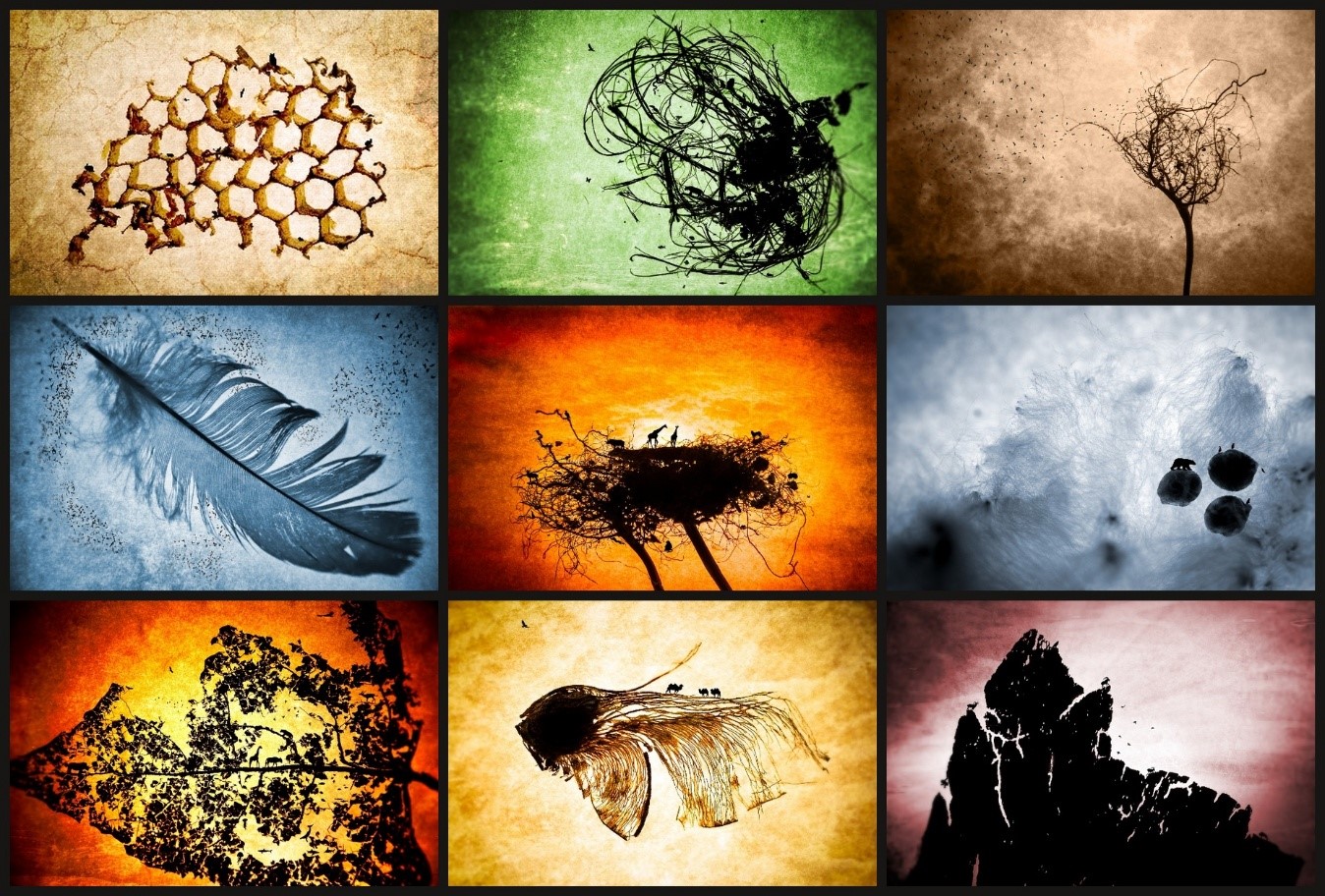
The series began almost by accident. John describes the first image this way: “The process was so fluid and natural it felt like the image had a life of its own. Once it existed, I knew I had something I would like to explore further.” And explore he did — though his hunting grounds were anything but exotic. He began collecting old, decaying fragments of nature: dried honeycomb, seed pods, feathers, tangled roots, skeletal leaves. Things at the end of their lives. Things most of us walk straight past without a second glance.
Under John’s macro lens, those fragments stop being debris and become geography. A few centimetres of honeycomb turn into a vast underground cavern; the fibres of a seed pod become a polar ice field; a pile of discarded roots becomes an African savannah at dusk. It’s a deliberate inversion of what macro photography usually does. Instead of magnifying a small subject so that we can admire its detail, John magnifies it until it becomes a landscape. The smaller the subject, the bigger the world.
Then comes the mischief. Into each of these imagined habitats John hides animals — tiny silhouettes tucked into the terrain, waiting to be found. A small eagle appears in almost every scene: John’s recurring signature, and a gentle nudge that you should probably look again. The idea traces back to his childhood and the hours he spent hunting for hidden treasures in densely detailed illustrations. Biomes was never meant to be scientifically accurate — no biologist would sign off on these habitats — it was meant to reward curiosity. These are images built for slow looking: the longer you stay with them, the more they give back.
That, to me, is why the series matters beyond its charm. It’s a quiet masterclass in the discipline John spent years teaching: that photography begins with seeing, and that the strongest ideas are rarely found in exotic locations or expensive gear, but in an ordinary object examined with enough patience and imagination. So, let’s take a closer look. You might be surprised by what you find.

John found this leaf on a walk through his local park; what caught his eye was its potential. The branching veins become strong leading lines that carry you through a landscape in miniature, while the tiny animals establish a surprising sense of scale. It’s the kind of image you look at once, then look at again and think, wait — was that there before?

Honeycomb becomes the foundation of an imagined underground world. The repeating hexagons set up a strong graphic pattern, while backlighting reveals the comb’s delicate, translucent structure — the light seems to glow from inside the earth itself. The soaring eagle is the first animal you’re likely to spot, exactly as John intended: your cue that more is hiding in the chambers below.

Flowing lines and warm tones evoke wind-sculpted dunes stretching beyond the frame. The repetition gives the composition a quiet rhythm, and the scattered animals lend just enough movement to keep the stillness from turning static. It’s a calm image — but never an empty one.

The idea came from a lighthouse John photographed while visiting Norway. Rather than showing the lighthouse, he set out to recreate the feeling it left him with. The stripped-back composition and generous negative space keep the image quiet and slightly haunting — a study in isolation where what’s left out does most of the talking.

The soft white fibres of a kapok seed pod become an imagined frozen world. Pale tones and delicate textures lend the scene a dreamlike quality, while the dark animal silhouettes hold their own against all that white. The animals would never share a habitat in real life — but this is John’s version of the poles, where imagination writes the field guide.

A weathered natural surface becomes a brooding mountain range. The rough texture pulls you in first; then you notice the tiny silhouettes along the ridgelines, and the “mountains” suddenly feel enormous. It’s the clearest example in the series of John’s gift for looking at something ordinary and seeing something else entirely.

The starting point was a pile of discarded blackjack roots. In the finished photograph, those tangles become the dry, winding terrain of an African savannah — an analogous palette of oranges and browns sets the mood, while a procession of giraffes carries the eye through the frame. The roots stop looking like roots at all. They look like somewhere giraffes might genuinely wander.

Layer upon layer of vegetation, with animals scattered through the undergrowth for you to find. There is deliberately no single resting place for the eye, so you keep moving through the frame, spotting something new on every pass. Busy, a little chaotic, and full of life — exactly as a jungle should be.

A composition built around movement: light, airy and full of energy, with flowing lines that pull the eye upward, as if witnessing a migration in progress. Once again John plays with scale, turning a small piece of nature into something that feels wide open.
More from John Fox
Biomes is only one thread of John’s work. The same imagination — and the same eye for what the rest of us miss — runs through his macro and fine art photography. Below is a small selection of his other works. Feel free to click on each image to see the full picture.


If Biomes leaves you with anything, let it be this: the next time you step over a dead leaf or a pile of roots, slow down. There might be a whole world in it.
