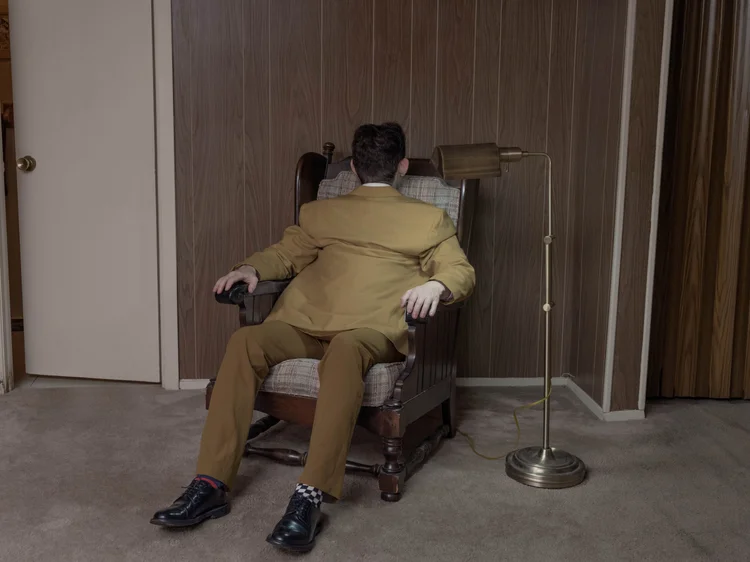
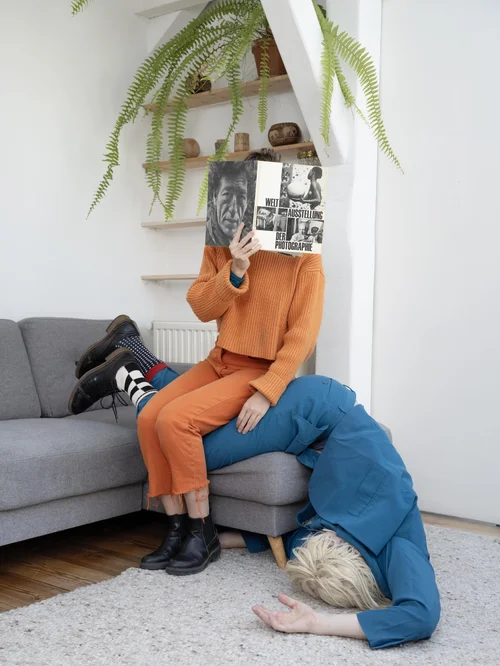

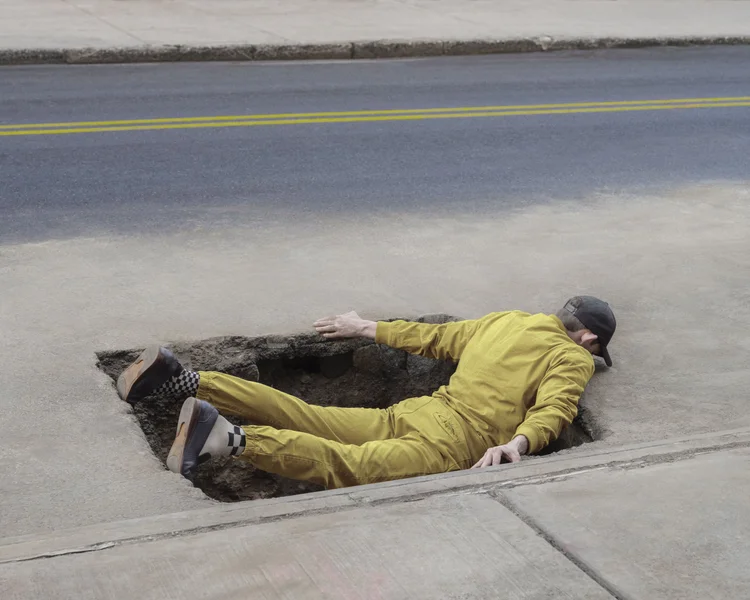

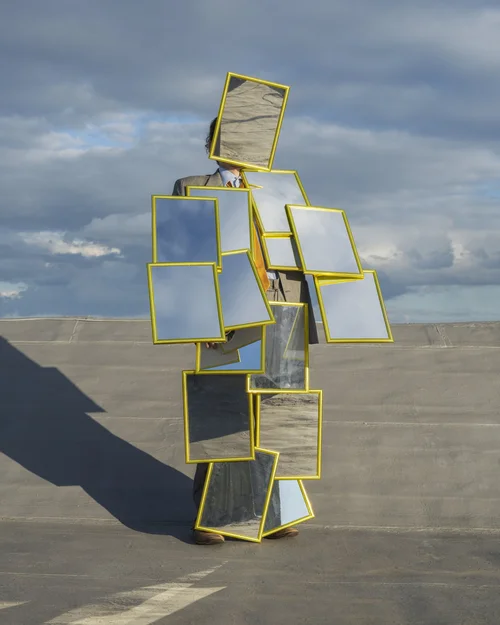
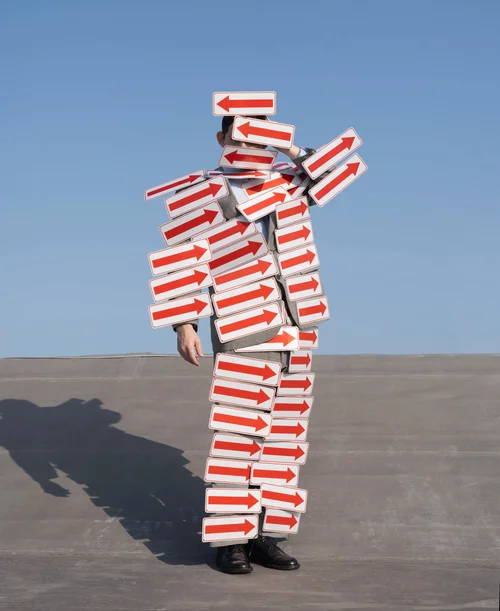
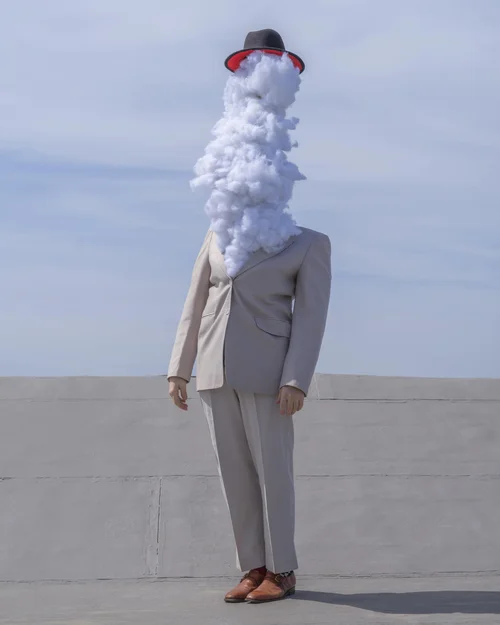
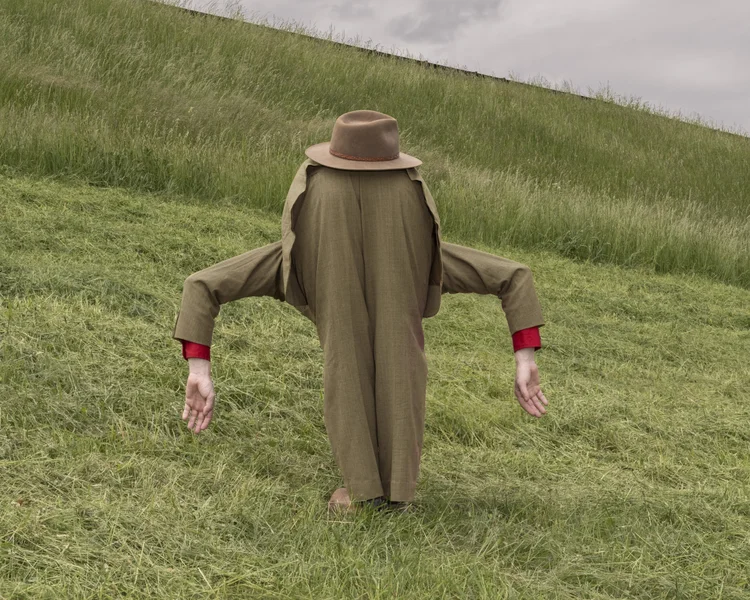
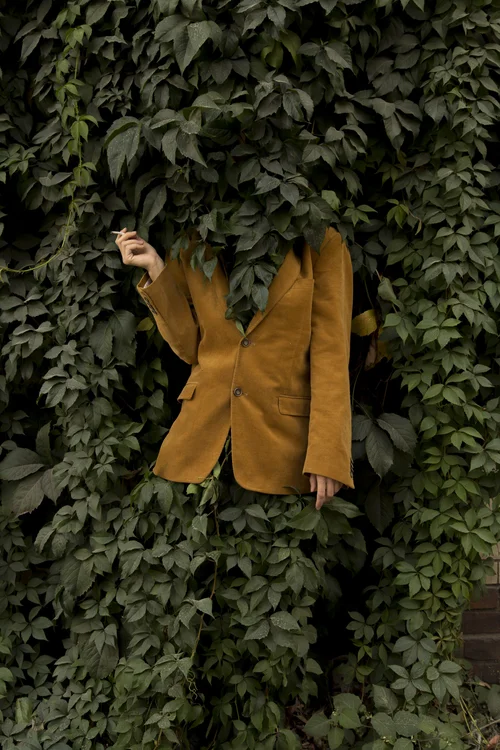
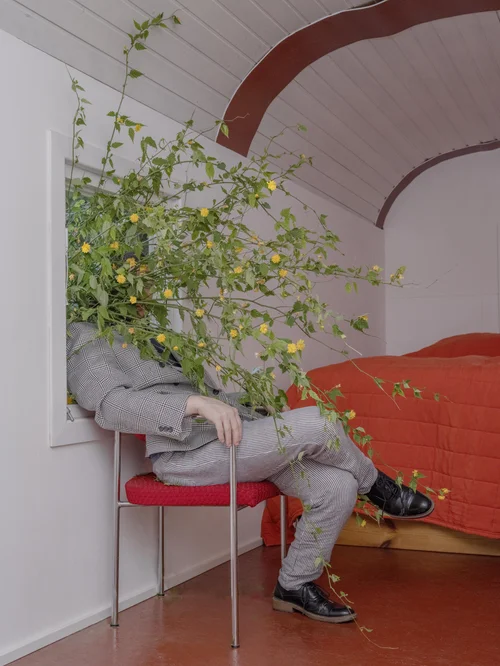
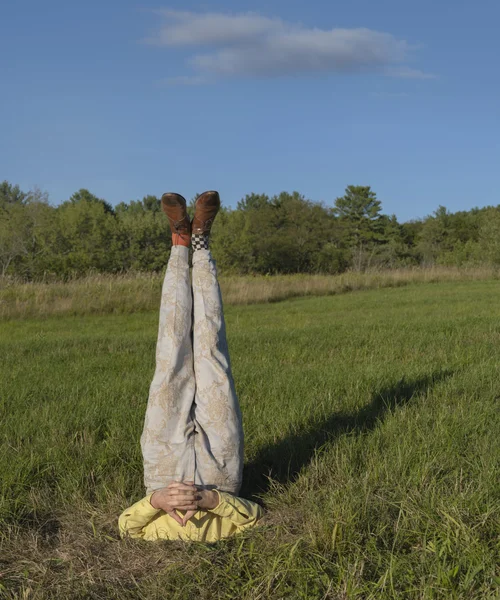
Born in the Bronx, New York, in 1991, Ben Zank discovered photography at age 18 when he found his grandmother’s Pentax ME Super camera in her attic. Initially studying journalism in college, he shifted to photography as a more subjective way to express emotions, finding photojournalism too restrictive. Over more than 15 years, Zank has built a career featuring international exhibitions in places like Berlin and Shanghai, along with features in publications such as Colossal and DesignBoom. His work often centres on self-portraits in odd, contorted poses against stark backdrops, using muted tones of greys, blues, and browns to evoke a subdued mood. Textures like cracked earth or peeling walls add depth, while negative space and tight crops heighten tension in his compositions.
- Primary Genres: Fine Art, Conceptual
- Primary Photography Style: Surrealism (minimalist, uncanny: twisting everyday scenes into bizarre, dream-like scenarios); Symbolism (narrative, introspective: using symbolic elements to explore inner emotional states)
- Key Message: Zank’s work probes themes of identity, isolation, and human absurdity, staging surreal self-portraits that transform mundane environments into quiet, unsettling narratives of existential unease.
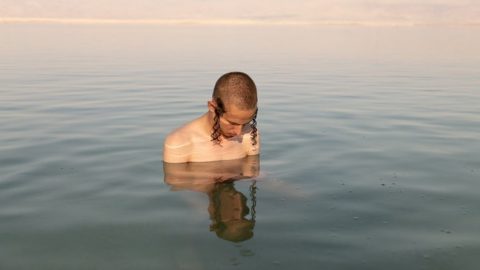
Zank’s most common subjects are solitary figures—often himself or faceless individuals—placed in improbable situations, such as heads buried in sand or bodies bent against natural or urban elements. This focus on the human form interacting oddly with surroundings highlights his unique aesthetic, emphasising contrast through desaturated colours and textured surfaces like weathered walls or earthy grounds. He employs techniques like shooting in flat, overcast light or dim interiors to maintain a realistic base while enhancing surreal effects, blending digital cameras with occasional 35mm film for a tactile quality. Editing remains minimal, with subtle adjustments to contrast and tone, plus occasional layering for distortions, ensuring the images feel authentic rather than overly manipulated. Presentation includes online galleries on his website and social media, small prints for sale, and his recent debut book, Nothing to See Here, which compiles self-portraits exploring precarious and bizarre scenarios.
For intermediate photographers, Zank’s style offers lessons in balancing surrealism with realism—think of it as starting with straight photography but introducing uncanny elements through composition, much like René Magritte’s influence on his riddle-like scenes. Unlike purely digital workflows that rely on heavy post-processing, Zank prefers film for its organic grain and unpredictability, encouraging learners to experiment with analogue formats to add subtle distortions without breaking immersion. His use of negative space mirrors the zone system in monochrome work, where mid-tones dominate to create contemplative mood, teaching how to amplify emotional impact through restraint rather than saturation.
Influenced by the monotony of early jobs, Zank channels personal frustrations into art, often working solo to foster an intimate self-dialogue during shoots. This approach underscores his emphasis on spontaneity over planning, allowing environments to dictate ideas on the spot.
- Accolades:
- Featured in Juxtapoz Magazine (2013)
- Solo exhibition “Routinized Absurdity” at Centre for Contemporary Art, Berlin (2018)
- Featured in Colossal (2017 and 2019)
- Portrait feature in The Harvard Crimson (2020)
- Trivia:
- Zank stumbled into photography at 18 by finding an old Pentax camera in his grandmother’s attic
- He frequently appears as the faceless subject in his own images to explore personal emotions
- Inspired by René Magritte’s surreal riddles, he incorporates puzzle-like absurdities in his composition
Lessons from this Photographer:
Zank’s unique approach lies in reacting spontaneously to surroundings, teaching photographers to let environments spark ideas rather than overplanning, which can lead to more authentic storytelling through composition. By using the self as subject, he demonstrates how to build intimacy and control in shoots, encouraging experimentation with body positioning and negative space to convey isolation or tension without words. Intermediate learners can apply his minimal post-processing mindset—focusing on subtle edits like desaturation—to preserve realism in surreal work, fostering a shift towards emotional expression over technical perfection.
Website and Instagram:
-
- Website: https://www.benzank.com
- Instagram: https://www.instagram.com/ben_zank
- Behance: https://www.behance.net/benzank
YouTube References:
- “Surreal Photography by Ben Zank #surrealism …” by Unknown Channel – https://www.youtube.com/shorts/H2bKsAdCnuQ
Citations:
- Portrait of an Artist: Benjamin R. Zank in The Harvard Crimson, 2020: https://www.thecrimson.com/article/2020/12/8/portrait-of-an-artist-zank/
- Ben Zank composes surrealist portraits in DesignBoom, 2019: https://www.designboom.com/art/ben-zank-surrealist-images-08-17-2019/
- The Surreal Photography of Ben Zank in Hi-Fructose Magazine, 2019: https://hifructose.com/2019/04/29/the-surreal-photography-of-ben-zank/
- Ben Zank – The Visual Fodder Interview: https://visualfodder.net/ben-zank-the-visual-fodder-interview/
- Ben Zank: A Surreal Visual Experience in Metal Magazine: https://metalmagazine.eu/en/post/ben-zank-a-surreal-visual-experience
- Nothing to See Here book announcement in PetaPixel, 2024: https://petapixel.com/2024/06/04/ben-zank-photographers-surreal-and-stunning-self-portraits-nothing-to-see-here/